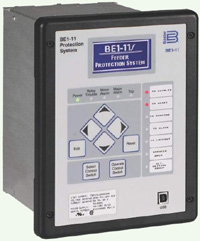
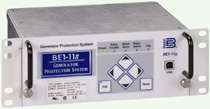
The H1 case offers
some unique benefits. The BE1-11f, BE1-951, BE1-851, BE1-GPS100,
and BE1-IPS100 are the smallest utility grade voltage/current
relays available.
H1
Case
The H1 case relays are
only 3.5" high, less than 9" wide, and less than 8" deep
behind the panel. This small package frequently allows
these relays to be “squeezed in” to an existing panel
space. They are extruded, brushed aluminum, fabricated
enclosures resistant to dust and moisture. Internal side
extrusions act as a guide for the drawout assembly and
provide a means to secure the drawout assembly in place
with two knurled knobs on the faceplate. Surface mounted
handles on the face of the drawout assembly facilitate
extraction of the drawout assembly from the case.
Terminal blocks in the rear of the case mate directly
with the drawout assembly when it is in the
fully-inserted position. Special automatic shorting
terminal blocks at the rear of the case are used on all
current transformer connections. Using dovetail
extrusions on the external sides of the case, two H1
cases can be fitted together to form a standard 19" rack
mount assembly.
S1 Case Numeric Relays
Basler offers 3 phase numeric feeder, intertie
and generator relays in the same S1 case as our
single function relays. These relays use the same
draw-out construction, test paddles, and cover
design as our traditional relays. They fit in
existing panel cutouts, plus testing procedures
and equipment are very similar to single function
devices.
Each
case consists of a fabricated steel and phenolic
enclosure that is resistant to dust and moisture.
They are designed to house either single or
double-ended relay units with one or two
connecting plugs as required for the specific
relay type. Round, washer head terminal screws are
located on the rear of the case for ease of
connection. These cases are capable of semi-flush
or projection mounting
F1 Case BE1-851
This unique package puts a BE1-851 3-phase numeric overcurrent relay into a single
FT11 (Westinghouse/ABB) cutout. The mounting holes
are in the same position. This makes it easy to
upgrade protection and add oscillography and
sequence-of-events recording to existing
installations. Each case consists of a fabricated
steel and phenolic enclosure that is resistant to
dust and moisture. Locking levers at the top and
bottom secure the drawout cradle to the case and
enable easy removal for inspection. They are
testable in case.